
Over the weekend, my social media feed was saturated with posts about pop musician Ed Sheeran’s concert and his opening act, Macklemore. The rapper began the show by coming on stage dressed in a keffiyeh and chanting “Free Palestine” to an arena that had paid to see a concert, not to hear a protest.
Just days before, I attended a discussion about online antisemitism and how the best thing you can do to stop feeding the algorithm is to ignore upsetting posts. I struggled not to engage with the images I saw of Macklemore depicting the rapper dressed in an offensive depiction of “a stereotypical” Jew with a crooked nose and leering smile. I fought against the instinct to slip into the comments section, which often leaves me feeling even more depressed. Yet it was hard not to see the headlines that kept shouting at me from my screen.
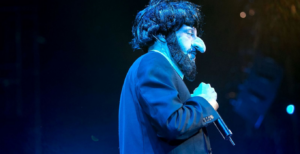
Macklemore in costume during one of his shows (Wikimedia)
These posts did something to me. As have so many posts by entertainers that have flooded my feed since October 7.
Naturally, I couldn’t help but think about the BTS concert I attended a week earlier with my daughter. Like the audience members who showed up for Ed Sheeran, we eagerly bought tickets for their concert in Chicago and counted down the days until we could be in the stands to watch them perform. These are experiences people save for, plan for, and look forward to – not to mention the fact that concerts are not cheap.
Thankfully, the concert was better than I could have imagined. It was magic, being surrounded by fans whose shared love of BTS made them feel like family. The show took my breath away, the way as did this K-pop group whose message to their fans centers on kindness, love, and acceptance. Most importantly, I shared an experience with my daughter that left us giddy and reminded me of all the joy a concert can bring.







Melissa and daughter at the BTS concert in Chicago, 2026 / image credit: Melissa W. Hunter
But in light of what happened recently at the Ed Sheeran concert, I couldn’t help but remember the little nagging thoughts that did creep into my mind while I was in those stands. As fans exchanged friendship bracelets and tiny gifts featuring BTS members, I noticed the audience’s diversity. The attendees were male and female, young and old, families and groups of friends. It was easy to see that different ethnicities, religions, and members of the LGBTQ+ community were represented. It was a glorious melting pot of strangers from different places and with different lives gathered together over a shared love of music.
And yet, sitting there, I had a thought I wish I didn’t have to have: What if?
What if someone noticed the Jewish star hanging around my neck? What if someone sitting in the audience nearby was wearing a kippah? And, perhaps most unsettling of all, what if the performers I had come to see said something that made me feel like I didn’t belong? Would that change the atmosphere around us for me and my daughter? Would I feel attacked and have to defend myself simply for being Jewish? Would I feel threatened and retreat without saying anything because I didn’t have the right words in that moment to speak up…a moment that shouldn’t be about anything but the concert?
Thankfully, that wasn’t my experience at BTS. But I can only imagine what a Jewish person at the Ed Sheeran concert felt when the music and celebration they had come to enjoy turned to political messaging that made them feel targeted or unwelcome. And when similar concerns arise again and again by artists who use their platforms to invoke antisemitism, whether they intend it or not, or believe anti-zionism isn’t the same thing as antisemitism, where does that leave Jewish fans who just want to enjoy music, or a concert, or a film or TV show? Are our concerns even being heard?
When I say I’m sick of all the righteous shouting, I’m not sure people outside my circle understand what I mean.
It doesn’t mean I don’t care about suffering. It doesn’t mean I don’t believe Palestinians deserve safety, dignity, and a future. It doesn’t mean I agree with every action of the Israeli government. I don’t.
However, it does mean there are nights when I lie awake worrying about how Jews are being perceived in the world. I worry about how easily an entire people can be lumped together as the enemy. I worry about the lies being told (colonizers, genocide) and the generalizations being made. I worry about how quickly nuance disappears, how complicated history can be reduced to a slogan, a video clip, or a few words on a social media post. I worry about this new wave of antisemitism and the voices that alienate us or lean into age-old conspiracies. I worry about our history being forgotten, diminished, or rewritten.
And I wonder, is this just me? Does the rest of the world care? Or do we each live inside our own echo chambers, surrounded by the issues that matter most to us while remaining largely unaware of what keeps someone else awake at night?
My cohost and I recently interviewed a political sociologist and peace negotiator trained in comparative politics and international relations for our podcast, The Kibbitz. One thing that stayed with me from this interview was our discussion on the complexity of peace itself. Yet we live in a society where information comes in snippets, sound bites, and viral posts, and it becomes incredibly easy to believe you understand an issue completely and the other side is wrong. It is nearly impossible to put yourself into another’s shoes, and only by doing so will real understanding and bridge-building begin.
So when I sat in the stands at the BTS concert, feeling that incredible kinship with the people around me, I wanted to believe this is what the world can be. For a few hours, all that mattered was the music and our shared love of this K-pop group, and by finding this thread that connected us, we were the same. We value the same things in our lives and want the same for our loved ones, our families, our society, and our futures.
The feeling I had in that stadium is the rule, not the exception. And when exhaustion creeps in after reading so many hateful posts, I remember that maybe that is what’s worth fighting for.