
A memorial bench was unveiled Tuesday honoring children who escaped the Nazis through the Kindertransport, a rescue mission that brought 10,000 Jewish children to safety before the outbreak of World War II.
The bench, located on the Barry Family Campus near the building’s main entrance, comes from a national initiative led by the Kindertransport Association (KTA). The association has donated memorial benches across the country to educate the public about Kindertransport and raise awareness of the children affected.
“The children’s separation from their parents and the complete uprooting from their childhood lives, and the parents who acted with unimaginable courage to save their children by sending them away to the unknown for an uncertain time, left emotional scars and enduring trauma,” said JCRC Director of Holocaust Education Susie Greenberg.
The Kindertransport began after Kristallnacht, an infamous pogrom against Jews in Germany. Following this, many Jewish families were looking for ways to escape Nazi Germany. While many countries were reluctant, they sympathized with the plight of children.
In December 1938, unaccompanied Jewish children were taken from Germany, Poland, Czechoslovakia, and Austria to countries where they could find safety. The United Kingdom took in the majority of these children, with Sweden, France, Switzerland, and Belgium taking in a smaller number.
The unveiling included the descendants of Kindertransport survivors. Marilyn LeviBaumgarten’s mother, Kitty Pappenheim, and one of her sisters were amongst the children sent from Vienna to England.
“My mother and one of her sisters went on it. I think it was the first Kindertransport out of Vienna. It was Hanukkah, 1938,” said Levi-Baumgarten. “My mother tells us that she remembers lighting candles on the train.”
Another local, Sandy Baron, shared the experience of her father, Kurt Moses, who was sent on Kindertransport at 11 years old.
“My dad ended up staying at [the lodge] in France, owned by the Rothschild family. He was there for about a year, with 135 other children,” said Baron. “After about a year, the children were moved to another French town, where living conditions were more difficult.”
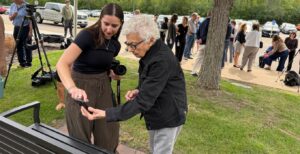
JCRC staffer Julia Fromstein shows Rivel Greenberg how to scan the QR code on the Kindertransport Memorial Bench. (Lonny Goldsmith/TC Jewfolk).
Baron explained that her father did not talk much about his experience, but eventually shared his story in an interview with the Shoah Foundation.
“I think he would be grateful that stories of the Kindertransport program are now being told,” Baron said.
Sir Nicholas Winton was a well-known individual of the Kindertransport, who rescued 669 Jewish children from Czechoslovakia and brought them to Britain. Winton’s son, Nick, who spoke at a Kristallnacht commemoration in Minnesota in 2022 and spoke to educators on a JCRC-sponsored trip in 2024, sent some words to be shared with the Minnesota community.
“The lesson from this is that we have more power to make a difference than we think,” Winton wrote. “We must take every opportunity to use it to the benefit of our community.”
The memorial bench includes a plaque with a QR code that links to the testimony of individuals impacted by the Kindertransport rescue efforts.
For those involved in the memorial bench, preserving history means not only remembering those who survived, but also the families who were forced to make an impossible decision.
“A bench cannot save 669 lives,” Winton wrote. “But it might change the thinking of one person who sits down for a moment, looks up, and discovers that they have more power than they think.”


My mother was a passenger on the Kindertransport, along with her younger sister.
One of my best donors when I worked at the ACLU-MN was a child of the kindertransport. She and a sib went from Austria to England where they lived with a very wealthy family in the countryside. They were not treated equally with the English children in the house, but they were fed, clothed and went to the local school. Her parents eventually escaped and joined them, working as servants in the home. I can’t remember her name, and I know she’s passed away. The family went to Canada; she married a non-Jew there and they moved to MN where her husband worked for 3M.