
I’ve always believed that when a reader can picture a place in a book so vividly that they can almost feel, smell, hear, and taste it, even without a single picture, the author has done their job beautifully. I feel the same way about cookbooks. We frequently rate a cookbook based on its photography. After all, our decision to cook something or not often starts with a picture. We see something remarkable, colorful, intriguing, and it is the picture that makes the decision for us. However, Jennifer Rinkoff, author of The Jewish Bakery: Over 100 Family Recipes from East London’s Oldest Jewish Bakery, has a gift of her own. While there are some simple photos throughout the cookbook, it is Rinkoff’s words that transport us in time and space.
We step foot into Rinkoff Bakery in 1911 when Hyman Rinkoff, a Ukrainian-Jewish immigrant to London, first opens the historic, now family-run bakery. We see how Hyman prioritized creating not just a business, but a community space. The cookbook carries that old-world atmosphere onto the page. Nothing is too over the top, the ingredients are very simple, the texture of the pages themselves like cardstock, not glossy, shiny finishes that we often see in new cookbooks.
We each carry a cholent pot in our hands, covered in dish towels, through the Jewish quarter of London. The walk takes less than 10 minutes, and we arrive at Rinkoff Bakery in time to place the pot in the communal oven for Shabbat, just like we did back in the shtetl. Twenty-four hours later the smells in the bakery are overwhelming in a calming way, before we even open the door. Rinkoff describes in detail how her great-grandfather made this Shabbat experience possible for so many immigrants away from their homes of origin and we are right there in the bakery with them.
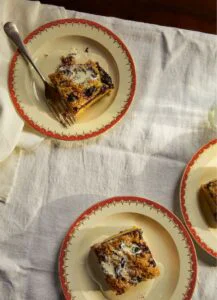
The Blueberry crumble cake from Jennifer Rinkoff’s The Jewish Bakery cookbook. (Photo by Kim Lightbody)
The Jewish Bakery reveals recipes for everything that can be put in an oven: from bread to cookies to cakes and pastries, there are traditional Jewish recipes and some non-traditional, non-kosher Jewish-adjacent recipes. We can see how Rinkoff Bakery kept traditions alive for generations but has never been afraid to adapt and grow.







All recipes come from things made and sold at the bakery today, including a challah recipe they’ve been baking at the bakery since Hyman opened the bakery in 1911. (Sometimes, our great-grandparents really did know best). There is something so special about being able to make these recipes at home and simultaneously envision a time when you can travel to London and try the bakery’s original versions. Rinkoff is sure to point out that “while we use large gas and electric ovens in the bakery, all the recipes in this book have been tailored to the home kitchen.” With most recipes kept to a single page and set in a straightforward, easy-to-read font, Rinkoff makes good on this promise. She further provides tips and tricks throughout of how to produce the best results such as keeping the oven closed as long as possible when baking to ensure cakes don’t collapse.
I particularly love the stories Rinkoff shares that disclose not only why a recipe is in the cookbook, but how it relates to her family. She notes that for Iced Beigels “we have a special way of eating them, by cutting through them and flipping them over, so the icing is in the middle.” This story is a family cookbook through and through, which adds a whole different dimension compared to other cookbooks on a Jewish bookshelf.
If I had to choose one disappointment with the book it would be the exclusion of the crodough recipe. Rinkoff explains that she introduced the crodough (a croissant-doughnut hybrid) to the bakery and it has “since gone on to become one of our bestselling products.” Yet, she adds that the recipe is top secret and not included in the book. It is hard to understand how something so defining of the bakery today (they even sell merchandise all about the crodough) could simply be left out. This absence feels opposed to the approach of the cookbook: to connect present to past, to keep traditions alive, to share old recipes with a new audience. But if Heimishe Cheesecake is any foreshadowing (its recipe was kept under lock and key for over 100 years and is now shared for the first time in The Jewish Bakery), perhaps the crodough is simply Rinkoff’s way of reminding us that some family recipes are still waiting to be passed down. Maybe there is another chapter to come.