

As Michal Rottenberg and Hanita Baram led groups of people into the “Through Their Eyes” exhibit of the experience of kibbutz Kfar Aza on Oct. 7, 2023, they made clear that showing the world what happened to the small community of 1,000 residents is necessary for people who may be uncertain about what Israel faced on that day.
“It’s very important that people see this exhibition, because it was from our eyes,” Baram said. “It’s the stories of our people in Kfar Aza. The real stories.”
Rottenberg, Baram, Liri Sobol, and Keith Siegel are Kfar Aza residents and survivors of the terrorist attack on their kibbutz on Oct. 7 who made the trip to Minneapolis for the opening days of the exhibit. Siegel and his wife Aviva survived captivity in Gaza; Aviva was released after 51 days, and Keith after 484 days.
“It’s important for us to tell our story, because people all over the world say it didn’t happen, and it happened to us,” Baram said. “My son was killed, murdered there. So I want everyone to know what happened. That’s why I’m here, and that’s why this exhibition is so important to me. To us.”
The exhibit had been in Israel before arriving in Minnesota, and has been translated to English for what organizers hope is the first of several visits in the United States.









Michal Rottenberg giving a tour of “Through Their Eyes” exhibit on Sept. 26, 2025. (Lonny Goldsmith/TC Jewfolk).
“It makes us happy to know that people who are English speakers will be able to try to understand what we had in Oct. 7 in Kfar Aza,” Rottenberg said.
“The exhibition was written, developed, and was born from Kfar Aza people. We are not people who used to do exhibitions or to post a lot of things. And it’s very intimate in private exhibition, and to see it in English, it’s very moving.”
The exhibit, at the Barry Family Campus now through Oct. 11, is in three different spaces. Starting in the auditorium, visitors learn about the residents who were killed in the attack, the kibbutz security forces who were killed defending the village, and the timeline of those who were taken hostage and when they were released – except for Ziv and Gali Berman.
The Bermans – now 28-year-old twins – were taken hostage and remain in custody. Sobol, the twins’ cousin, wore a t-shirt with their pictures on it.
“They were kidnapped … literally from their bed, in their homes in the kibbutz on the seventh of October,” Sobol said. “And they’re being held hostages for more than 700 days now, and we have no idea what’s their status, what their physical and mental condition is. From footage we’ve seen of other hostages, it does not look good.”
Sobol said that for those who got to experience the exhibit in the early days of the run is to meet the people from Kfar Aza.
“We’re being able to share a story firsthand so maybe it will be more touching and more personal,” he said. “So a mother can really imagine like it was her son kidnapped or even tragically dead.”
Keith Siegel, whose wife Aviva did not make the trip, spent time in captivity with the Bermans. The trip to Minnesota was his sixth to the U.S. since his release in February of this year, telling his story – and that of Kfar Aza – as often as needed.
“[I want] as many people as possible know what happened on Oct. 7, and from then up until this day,” he said. “Where Gali and Zivi are still being held hostage by terrorists, and they are in a life-threatening situation every day. And I know that as a fact because I experienced it and I know the suffering that they are experiencing, day in and day out.”





“The world needs to know the atrocities that Hamas committed and continues to commit up until this day,” Siegel said. “I think this exhibition shows that in a very vivid way, in a very accurate way, based on testimonies of people who experienced it.
“There’s a lot of there’s a lot of mis[information] or disinformation in the media, so this is an opportunity presented in a very accessible, visual [way] to see the pictures, the documentation, and people – me and other members of the delegation that are here – that can testify to what they experienced.”
The auditorium also contains television screens scrolling through different WhatsApp group chats, giving visitors a real-time glimpse of what the residents of Kfar Aza were a part of on Oct. 7.
The gallery contains images before and after Oct. 7, 2023. Idyllic scenes of kids playing, soccer fields, and parks, opposed by charred homes and walls covered by bullet holes.
The final area is the Testimony Room, where a video plays of three personal testimonies of survivors of that day, sharing the stories of those who were killed that day. Next to the Testimony Room is the Wings of Hope wall.
The original Wings of Hope was an art exhibit created by Livnat Kutz in Kfar Aza in July of 2023, taking old plastic toys and assembling them into wings on a wall of a shelter in the kibbutz. Livnat and her family were among those murdered in their home on Oct. 7. In Minneapolis, the outline of wings are painted on a wall, and several different colored Post-it Notes are nearby for visitors to leave a message of support, hope, prayer or reflection for the community; at the end of the exhibit, the messages will be delivered to the Kfar Aza community.
Rottenberg said that they are still fighting for the return of all who are left in captivity – the living so that they can heal, and those who have died for a proper burial.
“We have to fight in a lot of phases, but we have to show the world that we are resilient, that we can grow up from this tragedy and build our lives and our kibbutz again,” she said. “We don’t have any other choice. We can’t raise our hands and say, ‘Okay, I’m not continuing.’ We have to continue.”
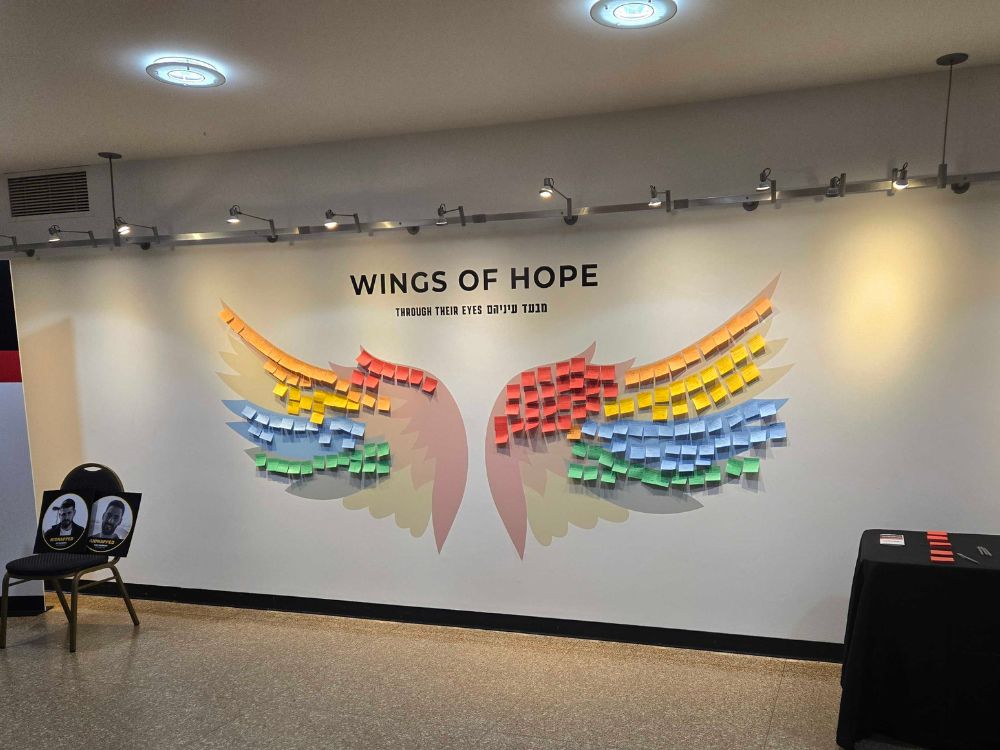
The Wings of Hope wall at the Barry Family Campus, part of the “Through Their Eyes” exhibition. (Libby Parker/TC Jewfolk).
Sharing their stories
As part of the visit to Minneapolis, the four Israelis were on the bima at a sold-out Beth El Synagogue in a conversation with author and activist Noa Tishby, who, before asking questions of the survivors, implored people to go to the exhibit.
“It humanizes a horrific event and the most unrecognizable pain,” she said. Tishby also talked about seeing the exhibit in Israel at a time when Siegel was still held in captivity.
“It was at a time when you were a photo on the wall,” Tishby said to Siegel. “Thank God, you are back home.”
The quartet talked about how long they’ve lived in Kfar Aza; Rottenberg since 2014, Baram for 31 years, Siegel for 42 years, and Sobol, who is 27 years old, was born and raised there. All are committed to coming back to the kibbutz.
“We’re going back home in commemoration of the 64 lives and the first responders so that they didn’t die in vain,” Sobol said.
Baram’s son Aviv was one of the first responders whose job is to help secure the village. He was one of a dozen against hundreds of terrorists who entered the Kibbutz. Baram said he sent messages to the family not to open the doors and to hold the handles of the saferoom doors so that they could not be opened.
Aviv messaged his wife that he was wounded while trying to help one of his fellow first-responders who was hurt.
“We tried to get help for Aviv,” Baram said.
Three days after the Kfar Aza survivors were evacuated from the kibbutz, Aviv Baram’s body was found next to his friend he had tried to help. His last text message to his family was “I love you all.”
“It’s up to me to tell his story,” Baram said. “I don’t feel strong. I struggle every morning to get out of bed. But my grandchildren and daughter-in-law and my other son need me.
“My oldest grandchild asks every day for stories about his dad. I need to be there for them.”
Despite the recounting of four of the horror stories of Oct. 7, Tishby said these were stories of hope.
“These are not stories of disaster but of survival and resilience,” she said.
Siegel said he endured the 484 days in captivity by closing his eyes and speaking to his family, and leaned into his Jewish faith and the catatrophes Jews have endured over millennia as inspiration.
“Being a part of the Jewish people gave me strength,” he said.



Will this exhibit be traveling elsewhere? I live in Maryland.