For decades, Chabad of Minneapolis had been tucked away on Hedberg Drive in Minnetonka, not far from Crossroads Deli in a series of anonymous office parks.
On September 3, after years of fights with the city, fundraising, planning, and construction, the community celebrated the ribbon-cutting of the new Chabad Center for Jewish Life on Hillside Lane in Minnetonka. The campus, named for Allan and Loni Stillerman and their family, is a short drive from the old space but a long way from where they were.

Minneapolis Chabad Rabbi Mordechai Grossbaum. (Lonny Goldsmith/TC Jewfolk).
“In June 2017, we bought the first two properties, and we thought we’d be in by Rosh Hashanah,” said Rabbi Mordechai Grossbaum to hundreds of supporters and well-wishers at the ribbon cutting. “Which Rosh Hashanah? God had different plans.”
The new building, spanning 13,000 square feet, includes a large main hall, a kitchen, and mikvahs. The center has hosted various events, including bar mitzvahs, weddings, and community gatherings. Originally, two lots were purchased for the construction project. By the time construction started, the project had expanded to five lots.








Despite the “grand opening” festivities of a ribbon-cutting, the building has been in use since November and more than 3,000 people have been in the building for various events over the past 10 months.
“We tried to get our certificate of occupancy in time for Rosh Hashanah and Yom Kippur last year,” said Grossbaum, who is the co-director at Minneapolis Chabad with his wife, Rivka. But immediately after getting into the building, there were several bar mitzvah celebrations and the bris of the son of Rabbi Shumli and Rochi Silberstein, who also work at Chabad doing adult and youth education, respectively.
“Somewhere shortly after was a wedding and then Hanukkah. We had three or four big programs with 300-something people here for Hanukkah,” he said. “It’s been very, very busy. Thank God.”
In the main sanctuary, instead of having pews like a traditional synagogue space, they set up chairs with rolling tables that prayer books can sit on. The idea behind that, Rabbi Grossbaum said, was to be able to reset the room fairly quickly as needed.
“We thought we were going to do that every month or so, and since we got here in November, we’ve done it way more than expected,” Grossbaum said. “The other reason is the style of davening here, they are much more comfortable with tables.”
With the divider opened up, nearly 300 people can sit at dozens of round tables that fill the space.
The building features a library that is used as a weekday shul for services or for a classroom for the Sunday school program. That room also has a dividing wall to create extra spaces.
With more than triple of the size of the former home, more can be done without leaving the building.
“The first Bar Mitzvah last November, we couldn’t have pulled off there,” Rabbi Grossbaum said. “For many Bar or Bat Mitzvahs, we had to take them out (of the facility).”
The Minnesota JCC – Sabes Center Minneapolis, was frequently a host, as was the Minnetonka Community or other theaters for larger programs. But those weren’t perfect solutions.
“The challenge of those [venues] are you show up with your goods, you got a couple hours to set up, and while the space is decent, it’s not home,” he said. “You’re walking through some other space and you don’t really have time to get set up. Over here, you can set up, potchke around a little be, and get it all organized hours before. And it allows you to work your schedule.”






Long road to opening
The cornerstone next to the front door reads October 2021, which is when the ground was broken on the project. The lag between groundbreaking and ribbon-cutting underscores the amount of time and fundraising that went into the project.
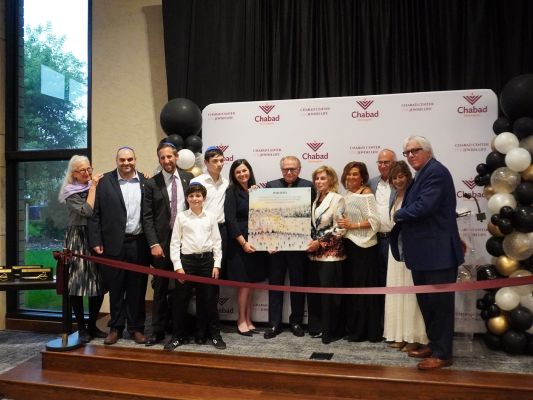
Allan Stillerman (center) and his family are honored for the naming donation of the campus for the Minneapolis Chabad Center for Jewish Life. (Lonny Goldsmith/TC Jewfolk).
The Minnetonka City Council approved the project in March 2019 after a lengthy back-and-forth with Chabad and members of the community. The publicly available documents in the meeting packet also included many letters of support, criticism, and other concerns and issues about the project.
The previous year, Minnetonka City Council denied Chabad’s application, which led to a significant revision of the plans that led to the building in its final form. The previous plan covered three lots and had driveway access off of Hopkins Crossroad; the vehicle access from Hopkins Crossroad could present a traffic safety issue which the council also considered in turning them down.
“Turning us down last time got us to a much better place, much better building,” Grossbaum said at the time. “It’s a much better use of the property, and hopefully, a safer Minnetonka.”
The properties that were purchased were demolished in May 2022, tree removal was done two months later.
The Chabad community in Minnesota was started by Rabbi Moshe Feller in St. Paul, and his influence led others to come to the Twin Cities, including Grossbaum’s parents – who came to St. Paul in the 1973. Despite being in St. Paul, the Chabad rabbis and rebbitzins led programming across the Twin Cities.
Rabbi and Rivka Grossbaum ran the Chabad summer camp in St. Paul in 1995 and then moved to Minnetonka to start the Minneapolis Chabad center in Elul of that year – the Hebrew month that it is currently. Their events were part of the Chabad “Living Legacy” Programs. Their first program was the Shofar Factory, a hands-on program that teaches children how the shofar is made. Rivka Grossbaum said that the Matzah Factory that may Jewish pre-schools open their doors for, is also part of the Living Legacy initiative.
“We’ve gone into every synagogue and every community center in the in the city, and been very much welcomed,” Rabbi Grossbaum said.
Rivka Grossbaum leads the Chabad Cooking Camp in the summer, which in the new space, hosted 100 kids each week.
“A lot of people came because they heard a word of mouth from their friend, and they trusted their friend,” Rivka Grossbaum said. “And once they came, they said ‘You know, I like it here.’”
Said Rabbi Grossbaum: “The building was full of kids. Literally every room.”
Still to come

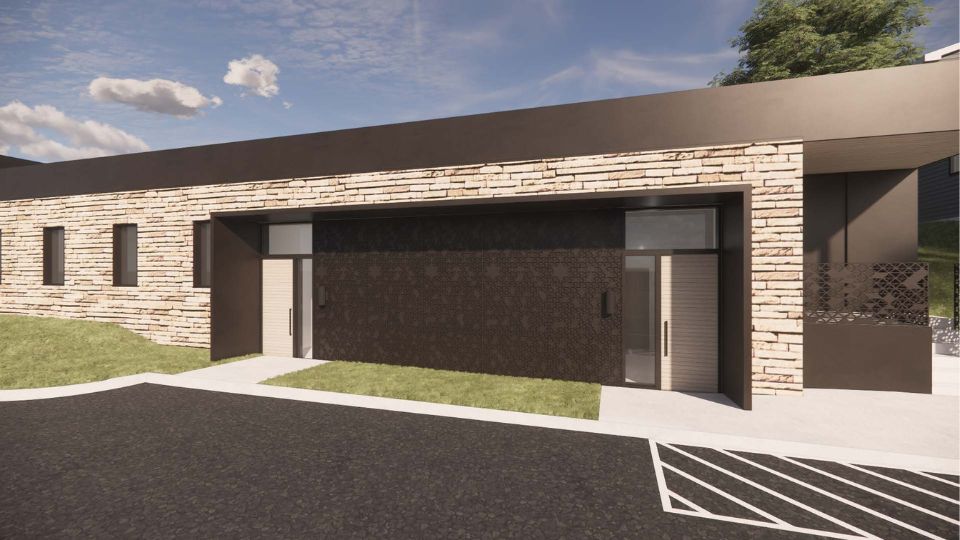
A rendering of the interior of the mikvah at Minneapolis Chabad. (Courtesy).
Most of the public spaces are completed, although some touches, like the dividing wall in the sanctuary, are still to come. The commercial kitchen is expected to be completed by the high holidays; since programming started, food was cooked in the Grossbaum’s home next to Chabad and walked over.
“No one is scared of the work, but it will make it a lot easier [to have the kitchen done]. And allow us to do so much more,” he said.
Phase two of the plans on Chabad’s website includes an education wing with five classrooms.
One of the areas of the facility that is not open to the public, but is coming closer to completion, is the mikvah. The facility, which will have private entrances, will feature a men’s mikvah, a women’s mikvah, as well as one for vessels. The mikvah facilities are in the process of being tiled, and the concrete for the facility was the first concrete poured in the project. Rabbi Gershon Grossbaum – Rabbi Mordechai Grossbaum’s father – is considered a world-renowned mikvah expert and led the planning of the facility. It was funded by an anonymous donor.
“In the Hasidic world, the men’s mikvah people use it before daily prayer, before the davening,” he said. “Some people use it on Fridays before Shabbos. A mikvah just enhances a community.”
Grossbaum said that according to Jewish law that if a community doesn’t have a mikvah, it should sell their torah in order to build one.
“Thank God we don’t have to sell any Torah scrolls because we have a number of mikvahs,” Grossbaum said. “But it gives an idea of how important it that extra purity and the mitzvah of mikvah is for women and how central it is for Jewish life.”


Baruch Hashem !!