What happens when you combine ancient Jewish wisdom, meaningful conversation, and a perfectly crafted mocktail?
On June 11, nearly 50 adults from across the Twin Cities gathered for Mikveh, Midrash & Mocktails, a collaboration between Jewfolk’s FolkLab and Maayanot Community Mikveh of Minnesota. The evening brought together people from across generations, backgrounds, and Jewish movements for learning, fellowship, and a deeper exploration of one of Judaism’s oldest and most enduring rituals.
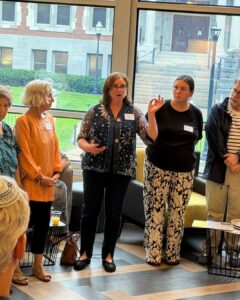
Cantor Rachel Stock Spilker, Maaynot’s founder and board president, talks to the group. (Juliana Sellers/Jewfolk).
And yes, there were delicious custom mocktails. (Thank you Cantor Spilker!)
Attendees enjoyed snacks and creative concoctions before breaking into learning sessions led by Rabbi Alexander Davis of Beth El Synagogue and FolkLab educator Sara Lynn Newberger.
The conversations could have gone on for hours!
Participants explored the basics of mikveh, its architectural elements, the concept of “living waters,” and the many ways ritual immersion has been practiced throughout Jewish history. But the evening quickly moved beyond facts and into something more personal: What does renewal mean? How does water transform us? Why do rituals thousands of years old continue to resonate today?
Again and again, participants returned to the idea that water changes us.
Water, paired with time, has the power to alter a person’s state. It can mark the end of one chapter and the beginning of another. It can help us move from grief to healing, uncertainty to clarity, stuckness to possibility. As one attendee put it, the mikveh offers a chance to “start again.”
Another fascinating thread of conversation centered on the preciousness of moving water throughout history. Long before modern plumbing, access to clean, flowing water was a luxury. Understanding that reality deepened appreciation for why water became such a powerful symbol in Jewish tradition and a reason why immersion remains meaningful today.
Participants also reflected on the emotional and spiritual dimensions of water. Water can absorb our tears, carry our prayers, and create space for reflection. It refreshes and rebalances us, helping us reconnect not only with ourselves, but with God, community, and generations of Jews who came before us.
The evening sparked discoveries and connections for participants of all backgrounds.
Stacy Brooks appreciated learning about the many nontraditional uses of mikveh and noted that the program was informative regardless of one’s previous familiarity with the ritual.
Elana Goldberg enjoyed conversations around renewal and the possibilities that emerge when we reconnect with ourselves and with God.
One attendee shared that he had always thought of mikveh primarily as a women’s ritual and was fascinated to learn that men have participated in immersion practices since ancient times. Another reflected on the idea that water itself offers a sense of possibility in the world.
Participants explored connections between the number 40 throughout Jewish tradition—the 40 days of the flood, the Israelites’ 40 years in the wilderness, and even the approximately 40-week human gestation period—discovering new ways to think about growth, transformation, and becoming.
Perhaps most powerful was the sense of continuity.
Many attendees spoke about feeling connected to one another through a tradition stretching back thousands of years. While much of the world has changed, the simple act of immersion in water remains remarkably familiar. There was comfort in that continuity, a reminder that renewal is not a modern invention but an ancient practice.
As the evening came to a close, participants gathered together once more, carrying with them new ideas, new connections, and perhaps a few lingering thoughts about water.
The conversations left many reflecting on renewal—not only of self, but of the world around us.
The message felt surprisingly hopeful.
We can wash away what no longer serves us. We can begin again. We can get unstuck. We can honor our own experiences while recognizing that everyone belongs in the story.
Like water itself, we are always changing.
And perhaps that’s exactly the point.
By the end of the evening, there was a palpable sense of connection in the room—a feeling that despite our different backgrounds, perspectives, and journeys, we were all participating in something larger than ourselves.
A tradition. A community. And the ongoing possibility of renewal.
It was a pleasure to participate in such a meaningful FolkLab event that grew out of community interest. Do you have an idea of a FolkLab program? Drop us a note at folklab@jewfolk.com and tell us what you’d like to experience, or check out our current classes to find something new to engage in!