

In the weeks following Oct. 7, a phone call between two friends led to a significant gift from the Twin Cities Jewish community, one that continues to save lives each day in Rehovot as the conflict continues.
Yoni Rottenberg, commander of the United Hatzalah unit in Rehovot, reached out to his close friend of more than a decade, Josh Awend, for help.
“Because of the situation that we had over here in Israel, they took all the ambulances down to the south, and so we had a big, big problem with ambulances over here,” said Rottenberg. “So I picked up the phone and called Josh, and I told him, ‘You told me that if I have a problem, to call you, so Houston, we have a problem.’ So I just said, ‘I’m gonna be like a regular Israeli with the chutzpah. You asked what we need. We need an ambulance.’ And it was silent for a second.”
Awend was leading a sales meeting in Golden Valley.
“I said, ‘Yoni, what do you mean? Do you want me to call a car dealership in Israel, put it on a credit card, and buy it? How do you envision this happening?’ He’s like, ‘I don’t know. Figure it out.’ And he hung up the phone on me,” said Awend.









After a brief laugh at the abrupt hang-up, Awend quickly got to work, making calls to the Minneapolis Jewish Federation to figure out logistics and raise funds for the ambulance.
“We had already launched our ‘Tikvatenu: From Heartbreak to Hope’ Israel emergency campaign, and many donors had already started to give very, very generously,” said Minneapolis Jewish Federation Chief Philanthropy Officer Steven Baker of a campaign that has raised nearly $13 million. “So at that point, we had raised several million dollars, and we got this request from Josh that came through, so we went to a donor who is going to remain anonymous, who we thought would be willing to contribute their gift to the Israel Emergency campaign to this specific effort, and the donor agreed.”
Several steps were required to secure the ambulance, including discussions with the municipality and other key stakeholders.
Once the funds were raised and logistics finalized, Ambulance 93 was dedicated in Rehovot at the Weizmann Institute during the first Tikvatenu trip in February 2024.
United Hatzalah is an Israeli rapid-response ambulance service to reduce wait times for people urgently needing treatment, thanks to a network of more than 8,000 volunteer medics throughout Israel.
The ambulance, proudly bearing a Minneapolis Jewish Federation logo and now numbered 52 after upgrades, has become one of Israel’s busiest, saving lives and serving as a daily reminder of the partnership between the two communities.
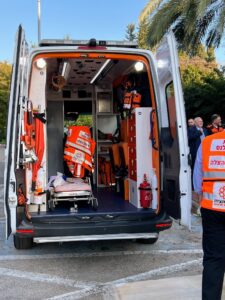
The inside of the former ambulance 93.
“We have Kaplan Hospital in Rehovot. It’s really close by, like a five-minute drive, and that’s one of the reasons why we really need that ambulance, because, instead of taking care of the person on the scene, since the hospital is so close, we can get the person to the hospital, like in 10 minutes,” said Rottenberg. “This is the most important thing: If you can get the injured person to the hospital as fast as you can, that is the best cure that you can get them.”
Awend reflected on his most recent trip to Israel in February 2025, during a Minneapolis Federation Business Committee meeting, where he got a firsthand look at the ambulance in action.
“Yoni met with everybody to talk with us about United Hatzalah, and at the end of the meeting, Yoni got a call,” said Awend. “He grabbed his walkie-talkie, and like there was all sorts of chatter, and he looked at me, he grabbed his vest, and he looked at me, we all just got up and ran out and jumped in the ambulance and went and took that call.”
Rottenberg and other members of United Hatzalah in Rehovot continue to share photos and videos of the ambulance in action, regularly sending updates through WhatsApp to their connections in the Twin Cities.





For Awend, the ambulance serves as a reminder that the work he has done with his community can have lasting, life-saving effects, even from more than 6,000 miles away.
“It’s like we’re bred for this. If all it took was to have a friend in Israel who thought ‘The only person I know right now that can help me is sitting in Minneapolis, and I know that if I call him as a fellow Jew, he’ll help me figure it out,’” said Awend. “As someone who craves that idea of helping, the ability to act on something tangible was such a no-brainer that it was like, of course, I’ll call everybody I possibly can to figure this out.”
Awend says the ambulance also serves as a reminder of what can be achieved through the strong bond between Minneapolis and Rehovot, a connection maintained in large part by the Minneapolis Jewish Federation, which helps link donors to urgent needs and nurture lasting ties between residents of both cities.
Baker said maintaining these strong connections is central to the Federation’s work.
“We are about connecting people, and that is really what the Partnership2Gether work through the Israel Center and the Jewish Agency for Israel with our sister city of Rehovot, is all about,” said Baker. “This is another beautiful example of those connections that we create and how they turn into meaningful impact.”