
More than 40 years ago, Israeli violin maker Amnon Weinsten embarked on a journey – acquiring and rehabilitating violins that had survived the Holocaust. And though he passed away in 2024, Weinstein’s son Avshi is carrying on his father’s work, which will be available for the community to see throughout May and June.
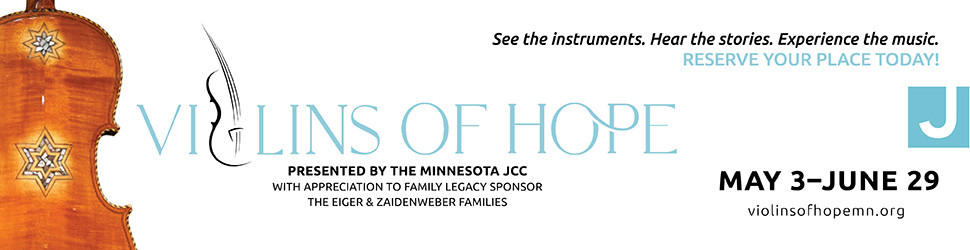
Violins of Hope, the result of the Weinsteins’ work, is being brought to Minnesota by the Minnesota JCC for more than four dozen events across the state (and South Dakota) from May 3-June 29. The program is made possible in part by the Zaidenweber and Eiger families as the Family Legacy Sponsors, as well as nearly 20 other foundations, organizations, and family funds.
The two months of events have been programmed by the Minnesota JCC, in partnership with more than 50 community organizations. Many of the events are available at no cost to increase accessibility.
“This was an opportunity to partner with many different organizations to bring the story of resilience to our community,” said Alex Fisher, the chief programming officer at the Minnesota JCC. “It becomes much more relevant with the recent upheaval in Minnesota and with the rise in antisemitism [around the country], it just seems like an opportunity to come together and show our resilience. Right here in Minnesota is the perfect time for this.”







Efforts to bring Violins of Hope to Minnesota started more than two years ago, and in that time, the program has been at sites around the world. Those stops have given JCC programmers some examples to work with.
“I would say that each residency is very unique,” said Katie Kline, the senior director of Jewish arts and culture. “There are certain common denominators: Most of them include, broadly, some concerts, some documentary films, and an education component. But each one is also really rooted in the local community and local partnerships.”
Said Fisher: “The breadth of this program is like none other that I’ve seen.”
Fisher and Kline said the dates for this have been on their calendar for more than two years – before either of them were in their roles at the JCC. Kline said that the response to the project were overwhelming among the community partners.
“Depending on which partner we’re referring to, some of them work really far in advance,” said Kline. “So like the St Paul Chamber Orchestra, we had to get on their calendar very early for these Ordway performances, because they have their calendars booked out months in advance. Others…don’t operate on such a long runway.”
The events in Minnesota start the evening of Sunday, May 3, with an opening reception, gallery opening, and JCC Symphony Performance at Minnesota JCC – Sabes Center, Minneapolis. There will be exhibits at both the Sabes Center and Capp Center in St. Paul for the entirety of the stay in Minnesota. There are also exhibitions at Orchestra Hall and the Museum of Russian Art, both in Minneapolis.
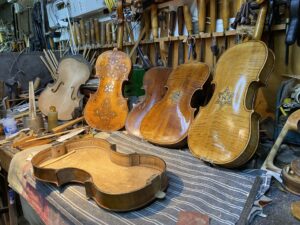
Instruments in mid-repair in Weinstein’s workshop.
One of the early highlights is celebrated violinist Itzchak Perlman’s visit to Temple Israel for the synagogue’s annual Voices: Ideas for our Time fundraiser. Kline said that Temple Israel wanted to participate in Violins of Hope in some way and was able to pair it with their annual fundraiser.
“We certainly offered the opportunity to every synagogue in town, and the vast majority took us up on the offer, and are creating some kind of programming around it, which has been really gratifying to see,” Kline said of the local synagogue participation. “In the same way that each residency is unique, each synagogue’s approach to how they want to present these instruments to their congregation is unique, and sort of just speaks to their unique personalities and takes on the residency and the initiative.”
While a 16-time Grammy winner like Perlman is an easy highlight, Kline said, picking a favorite event is “like picking a favorite child.”
One of the events that Kline said is meaningful to her is a May 13 event at Walker West, a historically Black music school in St. Paul’s Selby-Dale neighborhood.







“It’s an incredible school with just an amazing history, and we’ll be lifting up some of the common struggles of the Black and Jewish experiences at that event,” Kline said. “Events like that are really, I think, going to be impactful, even though they might be the less splashy ones.”
Educating about musical heritage
Avshi Weinstein said that about 70 instruments will be part of the exhibition in Minnesota, with about 60 still playable. Getting them to the playable stage is a journey.
“Anything from a month or two to two years,” Weinstein said. “You can restore almost everything, really. The question is, is it worth it?
“The value is not the money. The value is not in the instrument. The value is the story.”
Weinstein said there’s a violin in the collection of a girl who played in the Alma Rose orchestra in Birkenau.
“I would have never made a single dollar for this violin, let alone restore it and dare to sell it,” he said. “But that’s the violin that she learned how to play, and that’s why she was alive this way. She could go into the orchestra and stay alive.”
Weinstein learned the art from his father. Amnon studied to be a luthier in Cremona, Italy, at a violin-making school, followed by an apprenticeship in Paris. Avshi said that his father started playing violin and viola at a young age, but gave it up as he became more interested in the construction of the instruments. Avshi also played a little bit, but the mission of Violins of Hope hit very close to his family, as he is a third-generation survivor on his mother’s side.
“This was something that we lived very close to all our lives,” he said.
A significant component of Violins of Hope is Holocaust education.
“Usually people don’t realize how much music was there” during the Holocaust, Weinstein said. “And to have those instruments which were there and that you actually know their stories, it’s very strong emotionally.
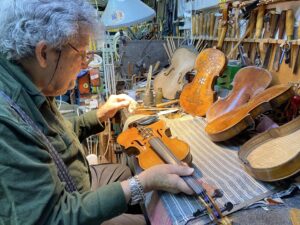
Amnon Weinstein z’l is working on rehabilitating a violin.
“We knew that they were musicians. Everybody knew that there was music, but we never knew the amount. And more intimate stuff: Pinchas Zukerman said his father got an extra piece of bread a week because he played in the orchestra.”
Susie Greenberg, the director of Holocaust education at the Jewish Community Relations Council of Minnesota and the Dakotas, said that music took on different roles and meanings. In some concentration camps, prisoners were forced to play in ”orchestras” for the entertainment of the Nazis, as well as when new prisoners arrived in the camps. These “orchestras” were often used as a means of propaganda to deceitfully show the broader public that Jewish prisoners were being treated humanely.
The musical performances were censored by the Nazis as a means of control and dehumanization, Greenberg said. Alternatively, singing and composing music was often done in private by Jewish prisoners as a means of self-determination and resistance- ultimately a symbol of freedom and expression.
“These violins are pieces that survived the Holocaust through different means and were played or were kept during that time,” Greenberg said. “And so each one of these violins and other instruments has a personal story.”
Said Weinstein: “The people who bring them [tell the stories]. There’s no other way, really.”
Weinstein said the children or grandchildren of survivors are the ones bringing him the instrument.
“This is family artifacts, much more than anything else,” he said. “The instruments themselves, these are not great stuff. The great stuff was confiscated, never to be seen again. But these are instruments that played in so many different places.”
Kline said there is one violin that was thrown off a train heading for a concentration camp.
“They shouted out the window, ‘Where I’m going, I won’t need this,’ and tossed it out, and a random villager finds it,” she said. “There are so many stories here, and bringing those stories to life is really, you know, the whole point of all of this. There are amazing stories, heartbreaking as well as resilient.”
The JCRC is one of the organizations sponsoring the exhibition; Greenberg said the organization was creating educational lessons around the music in the camps and its significance.
“We will…bring this component of history into the classroom,” Greenberg said. “So some of these might be Holocaust speakers talking about their family history, and then we incorporate a tangible component of history that people can touch and hear and see and smell and feel that is related to what we already do.”
1 comment